CAB in 2 Seconds, Not 2 Hours: Data-Driven Change Advisory Board Decisions
Table of Contents
Every week, CAB Chairs across the enterprise sit through marathon review sessions—manually triaging 50 to 200 change requests against spreadsheets that were outdated before the meeting started. The result: rubber-stamped approvals, missed conflicts, and outages that cost 10–50x more than the change itself. What if your CAB could assess every change request in 2 seconds with real-time external intelligence from 48 MCP tools, environmental awareness, halt reason cards for escalated changes, automated remediation tracking, and an ITIL 4 audit trail that your compliance officer will actually use?
1. The Business Problem
Change Advisory Boards were designed to be governance gatekeepers, but they have become bottlenecks. The numbers tell the story:
- 50–200 change requests per month require manual assessment in mid-to-large enterprises—each one reviewed against outdated risk matrices and tribal knowledge
- ITIL 4 CE.4 evidence gap: The Change Enablement practice (CE.4: Evaluate and prioritize changes, CE.5: Authorize changes, CE.8: Review and close changes) requires documented evidence of risk-based decision-making—evidence that manual processes cannot reliably produce
- 10–50x outage cost multiplier: A $5,000 change that causes a production outage generates $50,000–$250,000 in incident response, customer impact, and regulatory reporting costs. According to Gartner, the average cost of IT downtime is $5,600 per minute—$336,000 per hour
The fundamental problem is information asymmetry. CAB members make decisions based on what the change requester tells them, not on what the external threat landscape, infrastructure health, and compliance calendar actually show. No human can synthesize 26 external intelligence sources in real time—but an automated system with 48 MCP tools can do it in under 2 seconds.
2. The Demo Walkthrough
Step 1: Batch Assess 5 Change Requests Simultaneously
Instead of reviewing each CR individually, the CAB Chair submits the entire weekly queue to ComplianceHarbor’s batch_assess tool. Five change requests—a database migration, a firewall rule update, an Exchange server patch, a network switch firmware upgrade, and a new microservice deployment—are assessed simultaneously against all 26 external intelligence sources.
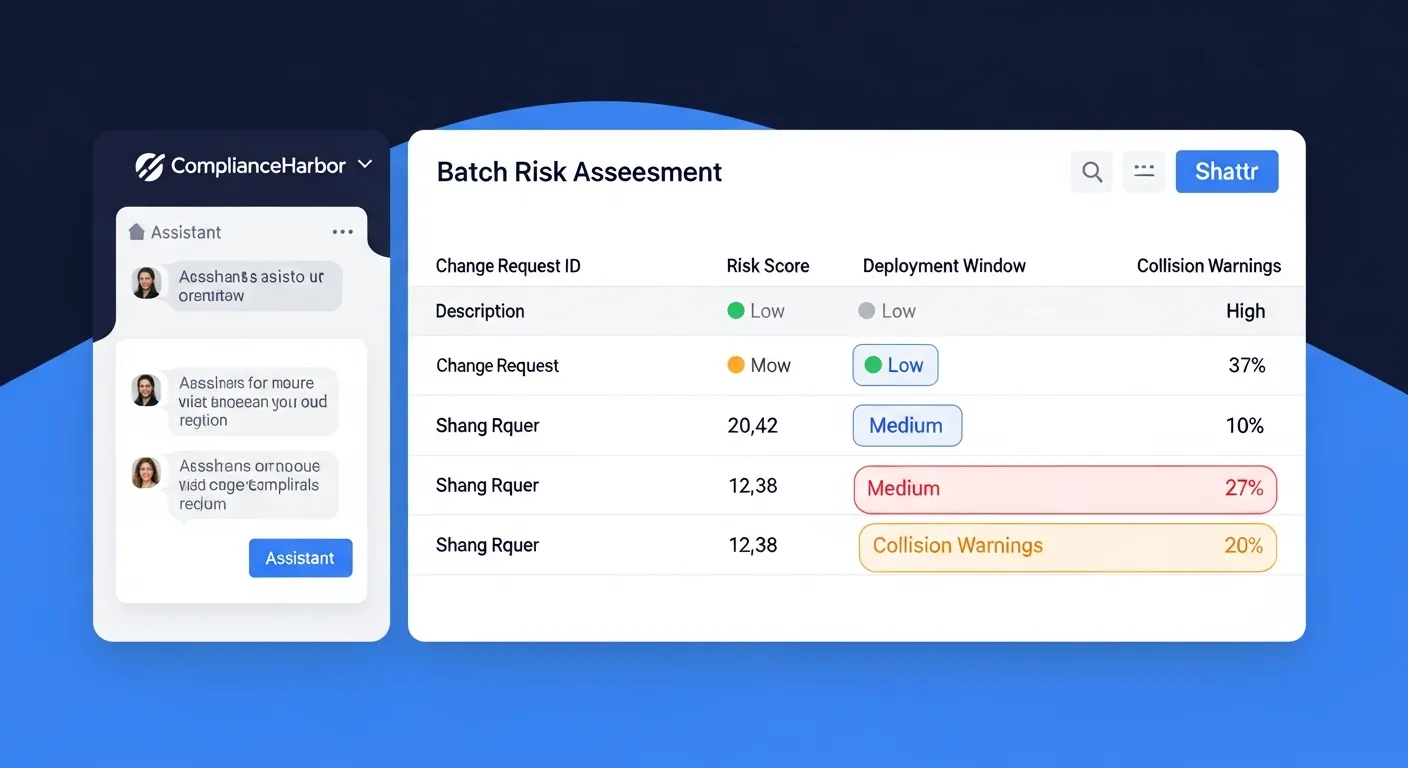
The results arrive in under 2 seconds. Each change request receives a risk score (0–100), a conflict count, and a top conflict summary. But the real value is the CI overlap warning: ComplianceHarbor detected that CHG-001 (database migration) and CHG-003 (Exchange patch) both target db-prod in overlapping maintenance windows. This is exactly the kind of conflict that manual reviews miss—and that causes 3 AM pages.
Step 2: Drill Into Individual Risk Scores
The CAB Chair sees that CHG-003 scored 72/100—HIGH RISK. Drilling into the assessment reveals why: active CISA KEV vulnerabilities affecting the target Exchange infrastructure, a MITRE ATT&CK TTP campaign targeting email servers, and a Patch Tuesday conflict window.
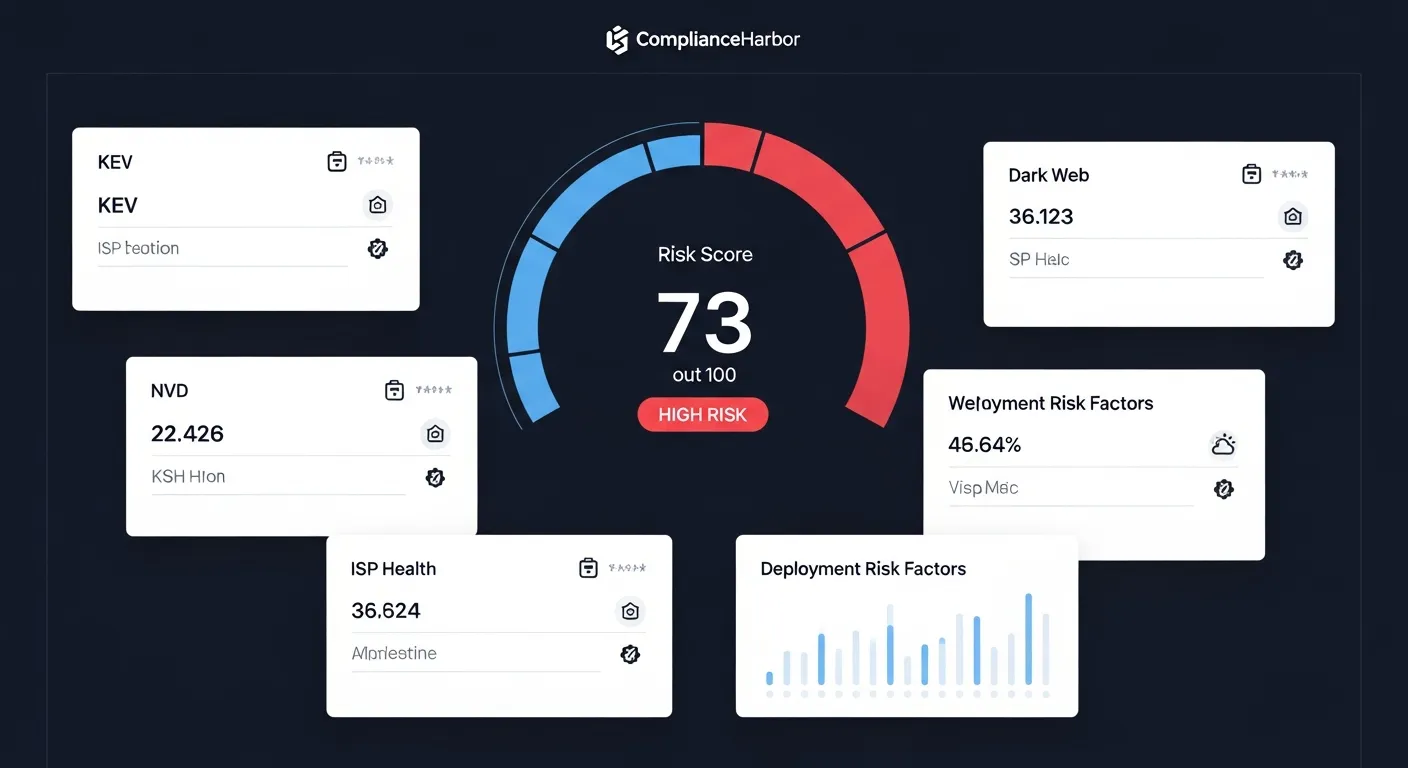
The threat surface tags show exactly which intelligence sources contributed to the elevated score. This is not a subjective “high risk” label—it is a quantified assessment backed by real-time external data from KEV, NVD CVE, ATT&CK TTPs, weather monitoring, dark web intelligence, and supply chain analysis.
Step 3: Check Patch Calendar Conflicts
Before approving the remaining changes, the CAB Chair checks the compliance calendar. ComplianceHarbor’s check_compliance_calendar tool reveals that CHG-004 (network switch firmware) falls within a SOX freeze period, and CHG-002 (firewall rules) overlaps with a PCI-DSS quarterly scan window.
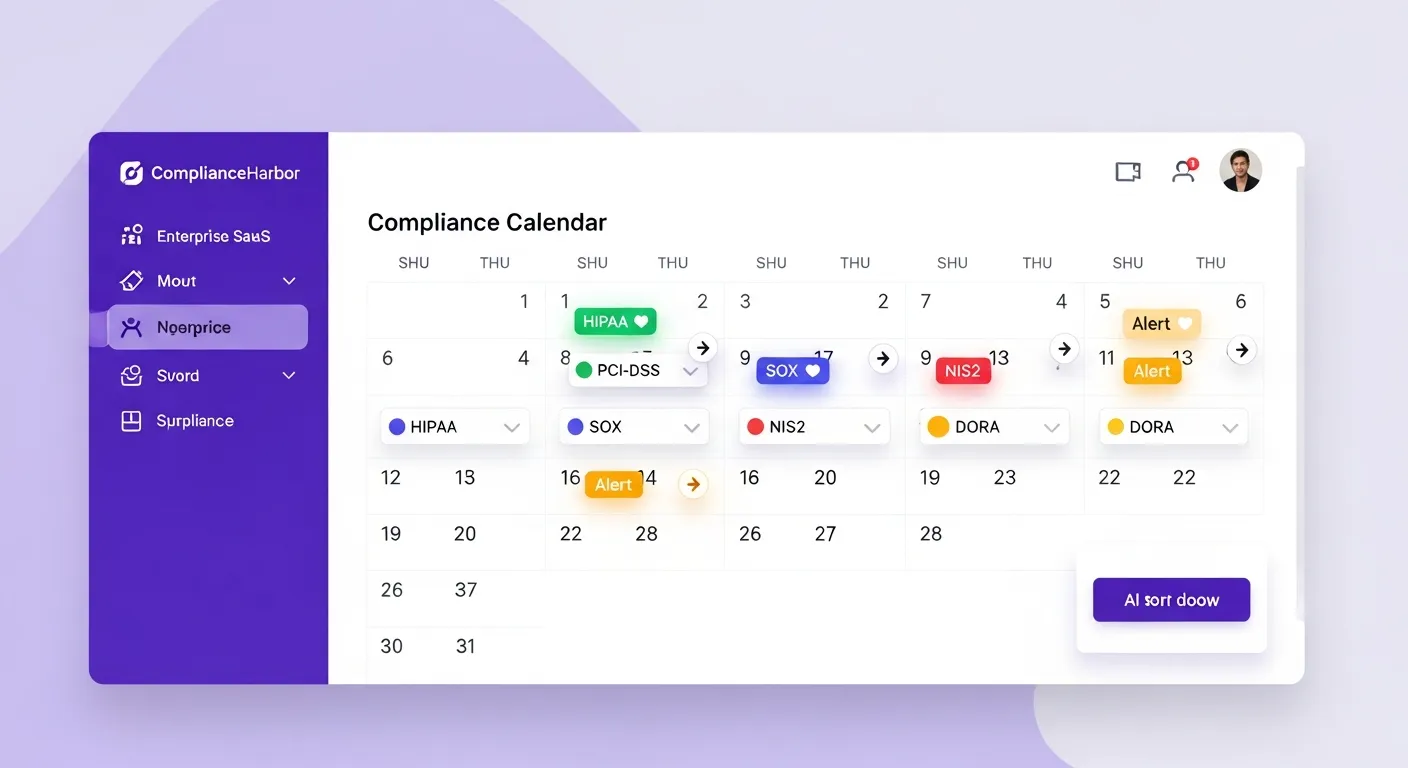
This is intelligence that no manual CAB process can reliably surface. The SOX freeze means CHG-004 must be deferred. The PCI-DSS scan overlap means CHG-002 needs rescheduling to avoid invalidating the quarterly assessment.
Step 4: Environmental and Infrastructure Intelligence
ComplianceHarbor goes beyond vulnerability and compliance data. The platform simultaneously checks:
- Datacenter weather: NOAA alerts for severe weather at datacenter locations that could affect power and connectivity during the change window
- Power grid status: Real-time grid stability monitoring for regions hosting critical infrastructure
- Disaster alerts: GDACS monitoring for earthquakes, floods, or other natural disasters that could disrupt global operations
- ISP health: Cloudflare Radar data on regional network stability and BGP anomalies
- Geopolitical risk: Sanctions, political instability, and trade disruptions affecting regions where changes are being deployed
For CHG-005 (microservice deployment targeting the Singapore region), ComplianceHarbor flagged elevated ISP latency in the APAC region and a geopolitical advisory for the South China Sea corridor. The CAB Chair defers the deployment to the following week when conditions normalize.
Step 5: Generate ITIL 4 Evidence Receipts
Every CAB decision—approve, defer, or reject—generates a cryptographically signed evidence receipt mapped to ITIL 4 Change Enablement controls:
- CE.4 (Evaluate and prioritize changes): The batch assessment with risk scores, conflict counts, and CI overlap warnings
- CE.5 (Authorize changes): The approval decision with the complete risk context at the time of authorization
- CE.8 (Review and close changes): Post-implementation risk posture comparison showing risk delta
Each receipt includes a SHA-256 integrity hash, ensuring the evidence trail is tamper-evident and audit-ready. No more scrambling to reconstruct CAB decision rationale months later when the auditor asks.
Step 6: Halt Reason Cards for Escalated Changes
When CHG-003 is escalated due to its 72/100 HIGH RISK score, ComplianceHarbor automatically generates a Halt Reason Card—a developer-readable summary that explains exactly why the deployment was flagged and what needs to happen before it can proceed:
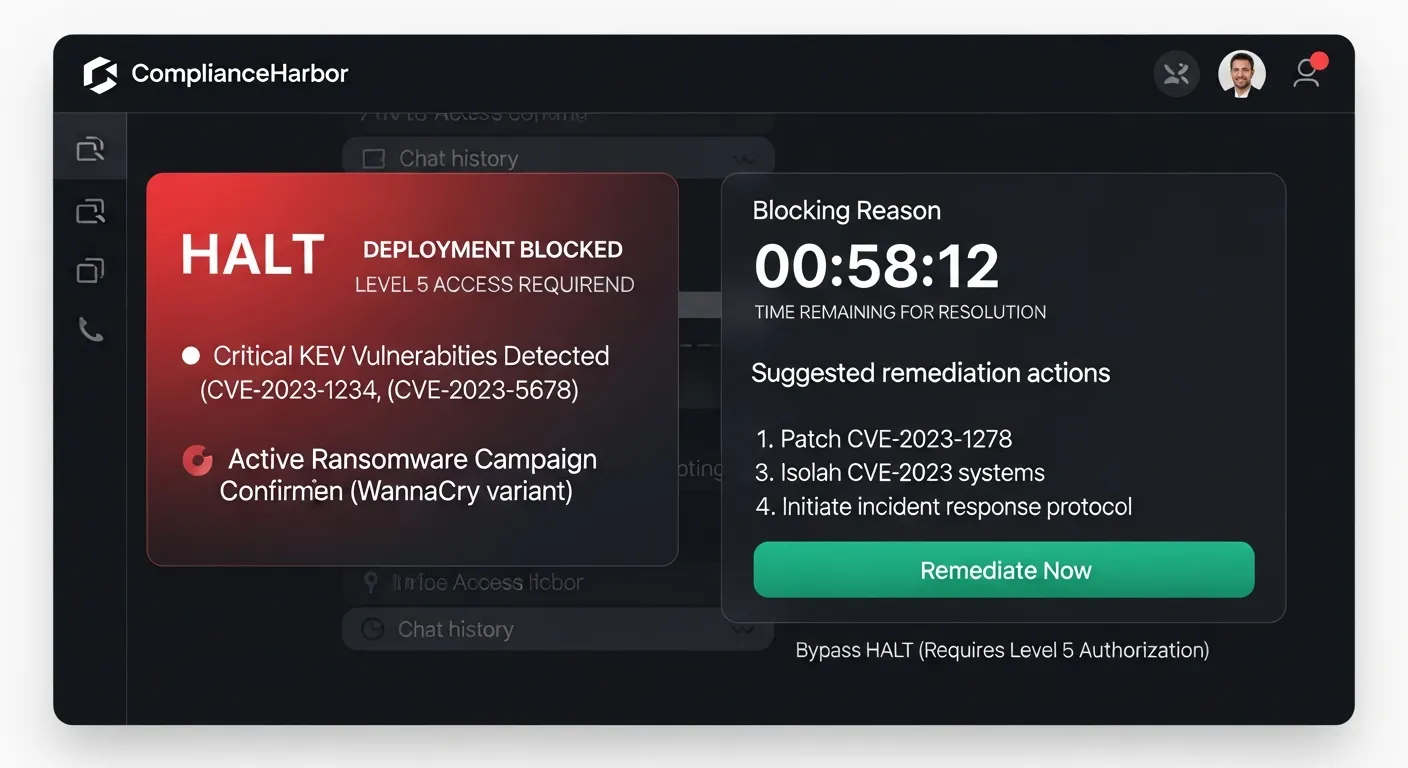
The Halt Reason Card includes:
- Headline: A clear, human-readable reason for the halt (e.g., “DEPLOYMENT HALTED: Critical CVE Detected”)
- Affected Components: The specific CIs and infrastructure elements impacted by the risk
- Estimated Risk Window: The time period during which the risk condition is active
- Clearance Type: Whether the halt requires manual review, automatic expiry, or executive override
- Estimated Clearance Time: A countdown timer showing when the risk window expires and the deployment can be re-evaluated
- Suggested Action: Specific remediation steps the change requester should take before resubmitting
- Reference URL: Link to the full risk assessment report for detailed analysis
This gives CAB members and change requesters a shared, unambiguous view of why a change was held and what the path to clearance looks like—eliminating the back-and-forth that slows down traditional CAB escalation processes.
Step 7: Auto-Create Remediation Findings for Threshold-Exceeding Changes
Changes that exceed risk thresholds don’t just get deferred—they automatically generate tracked remediation findings via the create_remediation_findings tool. CHG-003’s HIGH RISK score triggers a remediation finding that tracks the underlying vulnerability through its full lifecycle:
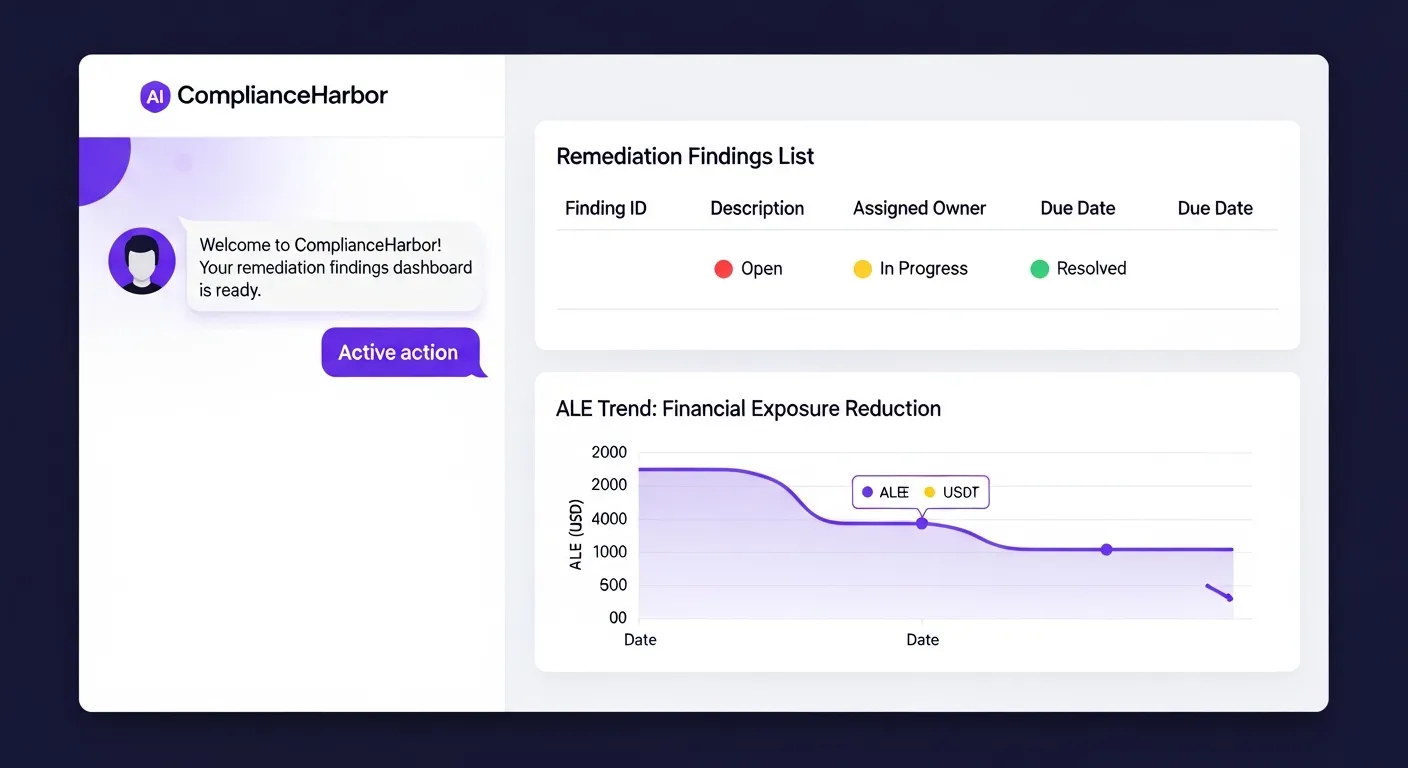
The remediation workflow ensures that deferred and escalated changes don’t fall through the cracks:
- Status Lifecycle: Each finding progresses through open → in_progress → resolved/accepted, with full audit trail at each transition
- ALE Trend Tracking: Annualized Loss Expectancy charts show how the financial risk exposure changes over time as remediation progresses
- SHA-256 Evidence Receipts: When a finding is resolved, a cryptographically signed evidence receipt is generated, linking the remediation back to the original CAB decision
- Closed-Loop Accountability: The finding links back to the original change request, creating a traceable path from CAB deferral to remediation completion
This transforms the CAB from a one-time gate into a continuous risk management loop—every escalated change creates a tracked work item that must be resolved before the change can be resubmitted.
3. Tools Included in ChangeIntel
| MCP Tool | What It Returns | CAB Value |
|---|---|---|
| batch_assess | Parallel risk scores for multiple CRs, CI overlap warnings, summary statistics | Assess the entire weekly queue in one call |
| assess_change_risk | Individual risk score (0–100), conflict list, threat surface tags | Deep-dive into flagged change requests |
| check_compliance_calendar | Regulatory deadlines, freeze periods, audit windows | Prevent changes during compliance-sensitive periods |
| check_datacenter_weather | NOAA severe weather alerts for datacenter locations | Avoid changes during environmental risk events |
| check_power_grid_status | Real-time grid stability and outage risk | Ensure infrastructure stability before critical changes |
| check_disaster_alerts | GDACS earthquake, flood, and storm monitoring | Global operational awareness for distributed teams |
| check_regional_isp_health | Cloudflare Radar ISP latency and BGP anomalies | Validate network conditions for region-specific changes |
| check_geopolitical_risk | Sanctions, instability, and trade disruption alerts | Risk awareness for changes in volatile regions |
| generate_evidence_receipt | SHA-256 hashed evidence with ITIL 4 control mappings | Audit-ready proof of every CAB decision |
| check_regional_resilience | Composite resilience score across power, connectivity, weather, seismic, and cloud dimensions | Regional infrastructure risk assessment for change planning |
| check_regulatory_pressure | Regulatory velocity, deadline density, and filing pressure metrics | Regulatory environment awareness for change scheduling |
| evaluate_rollback_trigger | Halt Reason Card with headline, affected components, clearance type, expiry timer, and suggested action | Developer-readable halt context for escalated changes |
| create_remediation_findings | Tracked remediation findings with status lifecycle and ALE trend data | Auto-create tracked findings for threshold-exceeding changes |
| list_remediation_findings | Filtered list of remediation findings by status, severity, or owner | Track open remediation items from deferred CAB changes |
| resolve_remediation_finding | SHA-256 evidence receipt confirming finding resolution | Close the loop when remediation is complete before resubmission |
4. Sample API Response
Here is the actual response shape from the batch_assess tool when evaluating 5 change requests simultaneously:
{
  "results": [
    {
      "change_id": "CHG-001",
      "description": "Database migration - production cluster",
      "risk_score": 31,
      "risk_label": "LOW",
      "conflict_count": 3,
      "top_conflict_summary": "Patch Tuesday overlap, minor weather advisory",
      "threat_surface_tags": ["NVD CVE", "Weather"]
    },
    {
      "change_id": "CHG-002",
      "description": "Firewall rule update - DMZ segment",
      "risk_score": 21,
      "risk_label": "LOW",
      "conflict_count": 2,
      "top_conflict_summary": "PCI-DSS quarterly scan window overlap",
      "threat_surface_tags": ["Compliance Calendar"]
    },
    {
      "change_id": "CHG-003",
      "description": "Exchange server patch - PROD-EXCH-01",
      "risk_score": 72,
      "risk_label": "HIGH",
      "conflict_count": 8,
      "top_conflict_summary": "Active KEV exploitation, ATT&CK TTP campaign, Patch Tuesday conflict",
      "threat_surface_tags": ["KEV", "NVD CVE", "ATT&CK TTPs", "Dark Web", "Supply Chain"]
    },
    {
      "change_id": "CHG-004",
      "description": "Network switch firmware upgrade",
      "risk_score": 30,
      "risk_label": "LOW",
      "conflict_count": 2,
      "top_conflict_summary": "SOX freeze period violation",
      "threat_surface_tags": ["Compliance Calendar"]
    },
    {
      "change_id": "CHG-005",
      "description": "Microservice deployment - Singapore region",
      "risk_score": 25,
      "risk_label": "LOW",
      "conflict_count": 2,
      "top_conflict_summary": "Elevated APAC ISP latency, geopolitical advisory",
      "threat_surface_tags": ["ISP Health", "Geopolitical"]
    }
  ],
  "summary": {
    "total_assessed": 5,
    "average_score": 35.8,
    "highest_risk": "CHG-003 at 72/100",
    "recommended_actions": {
      "approve": ["CHG-001"],
      "defer": ["CHG-002", "CHG-004", "CHG-005"],
      "escalate": ["CHG-003"]
    }
  },
  "ci_overlap_warnings": [
    {
      "change_ids": ["CHG-001", "CHG-003"],
      "shared_ci": "db-prod",
      "warning": "CHG-001 and CHG-003 share db-prod in overlapping maintenance windows"
    }
  ]
}
5. The Bottom Line
Your CAB just became a data-driven decision body—and every approval comes with an audit trail your ITIL 4 compliance officer will actually use.
In the time it used to take to review a single change request, ComplianceHarbor’s 48 MCP tools assessed all five, identified a dangerous CI overlap that would have caused a 3 AM production incident, flagged two compliance calendar violations that would have triggered audit findings, surfaced environmental and geopolitical risks that no manual process could have caught, generated Halt Reason Cards with clearance timers for escalated changes, auto-created remediation findings for threshold-exceeding risks, and generated cryptographically signed evidence receipts mapped to ITIL 4 CE.4, CE.5, and CE.8 controls.
The CAB meeting went from 2 hours of manual review to a 15-minute data-driven session. Three changes were approved with full audit trails. Two were deferred to safer windows with documented rationale and auto-generated remediation findings to track resolution. One was escalated for executive review with a Halt Reason Card and complete risk dossier. Zero were rubber-stamped.
That is the difference between a CAB that exists for compliance theater and a CAB that actually prevents outages.
Generate Shareable CAB & Window Optimization Reports
Use the generate_report tool with the cab_briefing report type to produce a server-rendered CAB decision summary, or use the window_optimization report type to generate a change window analysis report. Each report is available at a shareable URL (/report/:requestId) for 24 hours, giving you time to share it with CAB members, change managers, and ITIL 4 auditors.
Get Started
Start a free trial to see batch assessment, compliance calendar intelligence, and ITIL 4 evidence generation in real time.
Start Free TrialReady to get started with ChangeIntel?
See pricing →